
How to Check If a Soldier Is Real: A Complete Guide for Landlords, Law Firms, and Businesses
Some disputes pause the entire room the moment a person claims military service. Landlords stop an eviction filing. Attorneys rethink their next step. Companies hesitate on collections. The reason is simple. SCRA protections are powerful, and they only apply when someone is truly serving on active duty.
In the middle of that tension, you are the one who must decide whether the claim is real. It could involve a tenant resisting removal, a borrower requesting interest rate limits, or a defendant claiming they cannot appear because they are deployed. You cannot rely on stories, sympathy, or assumptions. Verification is required by law.
This guide walks you through the trusted methods that help you confirm a soldier’s identity with clarity and accuracy, so you can move ahead with confidence. Stay with us.
Key Takeaways
- Verifying military status is mandatory before filing evictions, lawsuits, debt actions, or default judgments involving a potential servicemember.
- The most accurate way to confirm whether a soldier is real is through an official Active Duty Status Report from the Defense Manpower Data Center (DMDC).
- Claims like “I’m in the military,” “I can’t be evicted because of SCRA,” or “I’m deploying soon” are not valid without official documentation or verification.
- Military ID cards, uniforms, or verbal statements are not reliable proof of active-duty status.
- Professional verification services help organizations obtain fast, court-accepted status reports to avoid compliance violations.
Why Organizations Need to Verify Military Status?
1. SCRA Compliance

Whenever a person involved in a case claims military service, the next step is verification. SCRA rules only apply to individuals on active duty; therefore, organizations must confirm a person’s status before proceeding with an eviction, debt action, or lawsuit. Once someone makes that claim, the risk of violating federal protections becomes real, which is why verification is not optional.
This requirement becomes even more important when considering the broad scope of SCRA protections. They apply to evictions, foreclosures, repossessions, interest limits, and default judgments, and each of these actions can result in penalties if taken against an active duty servicemember without proper checks.
A tenant may claim to serve in the Army or Air Force, but that information cannot influence your decision until it has been verified.
Courts also rely on accurate confirmation, which creates another reason to verify early. Judges often request a military affidavit before allowing a case to advance because they need clear information about the individual’s status.
If the affidavit confirms active duty, the court adjusts its approach. If the affidavit reveals no connection to military life, the case proceeds as normal.
Once verification is complete, the entire process becomes simpler. You avoid compliance issues, prevent case delays, and protect genuine servicemembers while ensuring false claims do not disrupt legal proceedings.
2. Fraud Prevention
False claims of military service appear more often than many organizations expect, which is why verification plays such an important role in protecting your case.
Some individuals use military stories to delay eviction, avoid repayment, or influence how a legal matter unfolds, and these situations place landlords and businesses in difficult positions when there is no confirmation of their actual status.
Once verification is part of your process, those risks decrease immediately. You are no longer relying on statements, sympathy-driven explanations, or sudden claims about deployment.
Instead, you have clear information that helps you determine whether the person is truly connected to military life. This step prevents cases from becoming complicated due to misleading claims and ensures your actions align with SCRA requirements.
3. Accuracy in Legal Proceedings
Courts depend on clear military verification because every ruling involving a potential servicemember must reflect their duty status. Judges cannot issue default judgments, approve evictions, or advance debt actions until they know whether the individual is actively serving, which is why accurate confirmation becomes a required part of the record.
As a case progresses, law firms and landlords must also demonstrate that they attempted to verify the person’s status through a reliable source. This documentation demonstrates that you followed the proper steps, thereby protecting your filings from being challenged later.
A verified report gives the court confidence and provides your organization with a stronger foundation to proceed.
Verification also serves the servicemember, since accurate information ensures that their rights are respected throughout the process. When both sides are protected, cases move in a more predictable and compliant direction, reducing delays and preventing unnecessary disputes.
Use a Professional Military Verification Service
1. SCRACVS
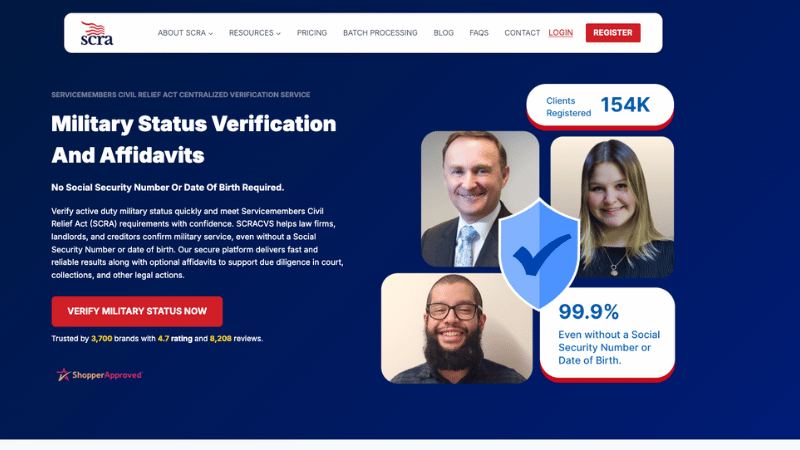
SCRACVS is the most dependable starting point when you need to confirm if a soldier is real, because the service produces fast, court-accepted verification that supports eviction filings, debt actions, and legal proceedings.
Organizations that handle SCRA-related cases rely on it for accuracy and ease of use, especially when internal teams do not have the time to troubleshoot government portals.
A major advantage is that SCRACVS can search even when you only have partial information. Many cases arrive with limited details, such as a name and approximate age or a name and address, and those details are often not enough for government systems that expect exact birthdates or full Social Security numbers. SCRACVS fills that gap and returns results you can use immediately.
Another benefit is the reduction of verification errors. DMDC lookups sometimes return mismatched numbers, incorrect birthdates, or inconclusive reports that pause the entire case. SCRACVS avoids these issues by providing results that meet SCRA affidavit requirements and are accepted by courts nationwide.
To keep the process simple, SCRACVS also offers civilian-friendly access and dependable support, which removes the stress of navigating federal portals. This matters for law firms, landlords, lenders, property managers, and anyone who needs verification they can trust.
When you put it together, SCRACVS becomes the most practical choice because it provides:
- The court accepted the verification suitable for affidavits
- Searches that work with limited personal information
- Fewer data mismatches compared to DMDC lookups
- Audit-ready documentation
- A straightforward process designed for civilian use
2. Use the Defense Manpower Data Center Active Duty Status Report
The Defense Manpower Data Center is the federal database that holds official records for active duty servicemembers. Courts accept its Active Duty Status Report as proof when reviewing cases that involve SCRA protections, which makes it an important verification method when complete personal information is available.
To generate an accurate report, the DMDC requires exact identifiers. You must have the person’s full legal name and date of birth, and the system works best when the Social Security number is included. These strict requirements ensure the right record is pulled, but they also create problems for organizations that only receive limited details from a tenant or customer.
When the information is incomplete or slightly inaccurate, the system may produce results such as:
- No results
- Error
- Unable to determine status
These outcomes leave you without confirmation, and they often slow down eviction filings or debt matters because the court needs clear documentation. This is one of the reasons organizations pair DMDC data with a professional verification service.
SCRACVS reduces the errors caused by mismatched identifiers and produces a court-accepted report even when the available information is limited.
Using the DMDC is valuable when you have perfect details, but it is not always practical for everyday situations where names, dates, or personal data are uncertain.
3. Request Official Military Documentation
Another way to confirm whether someone is a real servicemember is to request official paperwork that reflects their current status.
Genuine documents provide clear insight into whether the person is actively serving, preparing for deployment, or connected to a specific military branch. These records are commonly used in housing and legal disputes when a person claims SCRA protections.
Acceptable documents include:
- PCS orders
- Deployment orders
- Active duty contract
- Leave and Earnings Statement
As you review these materials, it becomes important to look for signs that something is incorrect. Fabricated orders are easy to find online, and some individuals attempt to use them to delay eviction or influence a legal outcome. Red flags can appear quickly, especially when the paperwork looks unusual.
Common red flags include:
- Missing signatures
- Cropped screenshots
- Suspicious formatting
- Lack of identifying information
Even when the documents appear legitimate, they should not be treated as final proof.
Each record needs to be cross-checked through a trusted verification method to confirm that the information matches current military records. This step ensures that your decisions are based on accurate details rather than paperwork that has been altered or created for misleading purposes.
4. Assess Indicators of False Claims
Some situations raise questions when a person claims to be a servicemember but cannot support that claim with basic information.
Verification becomes even more important when the details they provide start to shift or when their explanations do not line up with how military service actually works. These moments do not prove dishonesty on their own, but they signal that you need reliable confirmation before taking the claim seriously.
Several indicators tend to appear in cases involving false or exaggerated statements. These signs do not replace verification, but they help you recognize when a claim needs closer review:
- No documentation after repeated requests
- Statements such as “I cannot show you my orders because they are classified.”
- Claims of SCRA protection without appearing in court or providing any records
- Inconsistent rank, unit, or deployment dates
- Use of uniforms, badges, or accessories purchased online
When these issues surface, the safest next step is to verify through an official source.
What NOT to Use as Proof (Unreliable Indicators)
Some items may look convincing, but none of them confirm active duty status or satisfy SCRA requirements. These signals often create confusion, which is why they should never be treated as proof of real military service.
- Military ID cards. These are easy to fake, widely sold online, and illegal to copy or store for verification purposes.
- Social media photos in military uniforms. Images can be staged, outdated, or taken from someone else’s account.
- Verbal claims of rank or deployment. Statements alone cannot confirm service or duty status.
- A friend or partner confirming their service. Third-party claims hold no legal value.
- Civilian camouflage gear or military surplus clothing. Anyone can purchase these items without serving.
- Claims such as “I am deploying next week” are made without documentation. Official records must always support deployment information.
Using these items as proof places your organization at risk, which is why courts rely only on verified documentation rather than informal indicators.
Why Verification Protects Your Legal Case?

1. Preventing SCRA Violations
Verification strengthens your case because courts require accurate information before issuing any ruling that involves a potential servicemember. Once you confirm duty status, every action you take aligns with the legal protocol expected under SCRA.
SCRA violations can result in reversed judgments, fines, and, in some cases, federal intervention. These issues often arise when a case moves forward without confirmation of military service. Verification removes that risk by providing clear documentation that supports the steps you take.
With verified information in place, your filings remain compliant, your timelines are clearer, and your case avoids challenges that arise from relying on unconfirmed claims.
2. Ensuring Valid Eviction, Foreclosure, or Debt Actions
Courts expect a verified military affidavit before they review any eviction, foreclosure, or debt-related action. Without it, the filing is incomplete, and the court cannot move forward. This requirement exists to make sure that anyone who may be on active duty receives the protections they are entitled to under SCRA.
When a filing lacks proper verification, the case often stalls. Judges may return the documents, request additional proof, or pause the matter entirely. These delays increase legal costs and extend the time it takes to reach a resolution.
Verification prevents these issues by providing the court with the necessary information to proceed.
3. Strengthening Documentation
Clear verification records add stability to any case that involves a potential servicemember.
When your documentation includes confirmed military status, you create a reliable trail that supports every action taken during the eviction, foreclosure, or debt process. This level of accuracy protects your organization from future disputes because the information is complete, current, and aligned with SCRA expectations.
Reliable vs Unreliable Ways to Check if a Soldier Is Real
| Method | Reliable | Notes |
|---|---|---|
| DMDC Active Duty Status Report | Yes | Government-issued and requires exact identifiers |
| Professional Verification Service | Yes | The court accepted and works even with limited information |
| Official Orders or LES | Yes | Must include dates, signatures, and identifying details |
| Social Media or Photos | No | Easily faked and not valid proof |
| Verbal Claims | No | Not acceptable in legal proceedings |
| Military ID | No | Illegal to copy and not reliable |
Stay Protected and Compliant with Verified Military Status Reports
Verifying whether a soldier is real protects your case, your organization, and anyone who may be serving. When you rely on confirmed military status rather than assumptions or informal proof, every decision becomes more accurate and fully aligned with SCRA expectations. This prevents disputes, avoids avoidable delays, and keeps your filings grounded in documented facts instead of unreliable indicators.
Official verification tools provide clarity in moments where stories, screenshots, or verbal claims create uncertainty. Once you work with verified records, you eliminate the risk of acting on incorrect information and ensure that any servicemember involved receives the protections they are entitled to under federal law.
Before you proceed with an eviction, foreclosure, debt action, or legal filing, confirmation of duty status is essential. It keeps your process defensible, compliant, and supported by the documentation courts expect.
Military Verification provides fast, accurate, court-accepted military status reports that make compliance simple and reduce legal exposure. If you want dependable verification you can use in any filing, register here.
FAQs
How can you tell if someone is a real soldier?
You can confirm if a soldier is real by verifying their active duty status through the Defense Manpower Data Center or a professional service like SCRACVS. These sources check official military records across the Army, Air Force, Marine Corps, and other branches. Avoid relying on social media photos, stories, or verbal claims, since those can be fabricated and used by a romance scammer or stranger seeking sympathy.
How to spot a fake military person?
A fake soldier often avoids providing documentation, changes their stories about rank or deployment, or claims they cannot share orders for security reasons. Many use social media photos, online uniforms, or emotional stories to mislead people. If you notice red flags or inconsistent information, verify through a trusted service to stay safe and avoid falling prey to scams.
Can you check if someone was really in the military?
Yes. You can verify a person’s military service by requesting an official Active Duty Status Report or using SCRACVS, which can search with limited information. These tools confirm whether a person served, currently serves, or never belonged to the armed forces. Avoid relying on conversations, dating site profiles, or unverified photos, since those often mislead victims.
Are military records public?
Most military records are protected due to the sensitive information they contain. Certain basic details may be requested through the Information Act, but full service records are not publicly accessible. Active duty status requires verification through official channels such as the DMDC or SCRACVS because civilians cannot view complete files.
Can civilians see military records?
Civilians cannot access full military records because they contain private identifiers. Only limited information may be released under specific conditions. To determine whether a person is currently serving, civilians must use the DMDC Active Duty Status Report or a verification service that cross-checks military life data without exposing confidential details.
How do landlords and law firms verify active duty military status?
Landlords and law firms verify active duty status through the Defense Manpower Data Center or a professional service like SCRACVS, which provides court-accepted reports using limited personal information. This ensures accurate results even when the person offers minimal details. Verification protects the organization from falling victim to false claims during eviction, foreclosure, or debt actions.
Do courts accept military verification reports from SCRACVS?
Yes. Courts nationwide accept SCRACVS military verification reports because they reflect real data from the Defense Manpower Data Center and meet SCRA affidavit requirements. These reports help prevent errors caused by mismatched Social Security numbers, incorrect dates, or incomplete identifiers. Law firms and businesses use SCRACVS to protect filings and support compliance.
Are military ID cards reliable proof of active duty status?
No. Military ID cards are easily forged, frequently sold online, and are illegal to copy or store for verification purposes. A real soldier’s identity cannot be confirmed through an ID alone. Courts require verified documentation from the DMDC or a professional service rather than photos, cards, or verbal claims that strangers often use to mislead people.


